
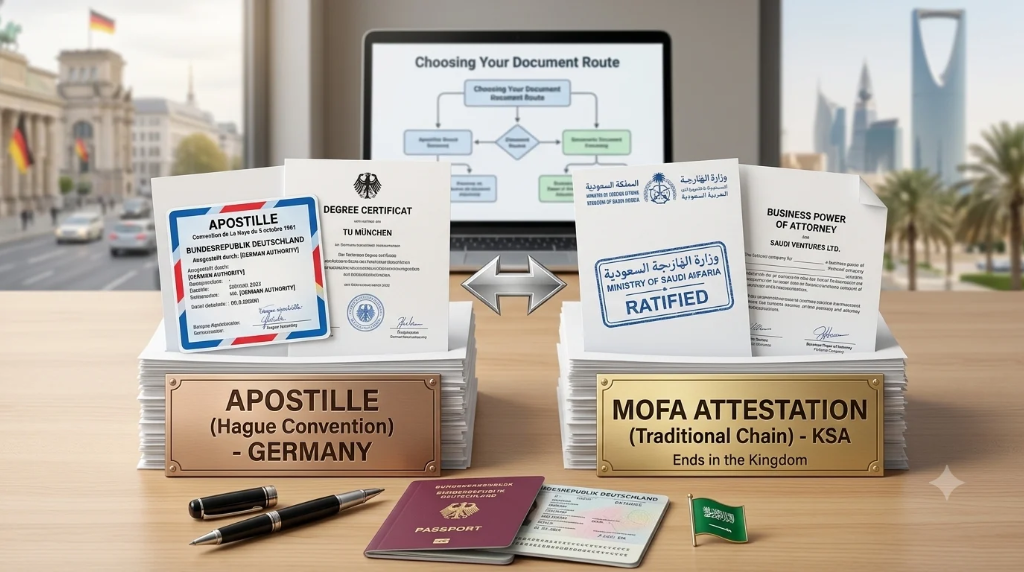
Apostille vs MOFA attestation: an apostille replaces the older embassy chain that ends with MOFA. An apostille is one Hague certificate from the country that issued your document. MOFA attestation is the Saudi ministry’s final stamp in the older chain.
Saudi Arabia joined the Hague Apostille Convention in April 2022, and it took effect in December 2022. That ended the old rule that every foreign document needs embassy legalisation. It did not stop Saudi recipients from setting their own conditions for acceptance.
This guide is for job seekers, HR teams and companies who must pick a route before paying. It shows the differences, the edge cases and a simple way to check your own file.
Apostille vs MOFA Attestation: The Short Answer
An apostille comes from the competent authority of the country that issued your document. MOFA attestation comes from the Saudi ministry, at the end of the older embassy chain.
| Point | Apostille | Traditional chain with MOFA attestation |
| Legal basis | 1961 Hague Apostille Convention | Each country’s own rules, plus Saudi MOFA’s ratification service |
| Who issues it | Competent authority of the issuing country (India’s MEA is one example) | Notary, foreign ministry, Saudi embassy, then Saudi MOFA |
| Where it happens | In the issuing country | Abroad first, then in the Kingdom |
| Number of stages | A preliminary check, then one apostille | Up to five stages |
| What it proves | The signature, the signer’s role and the seal | Each stage confirms the signature added before it |
| Scope | Between Convention countries | Any country, including non-Convention countries |
| Fee | Set by the issuing country (HCCH lists SAR 30 for Saudi-issued apostilles) | MOFA’s e-service page lists no fee amounts |
| Guarantees acceptance | No | No |
Do not pick a route by counting stamps, because the number of stamps proves nothing. Check first whether the Convention applies, and then what your Saudi recipient accepts.
What Is an Apostille?
An apostille is a standard certificate that confirms where a public document came from. It checks the signature, the signer’s role, and the seal or stamp on the document. It does not prove the content is true or force anyone to accept the document.
The Hague Conference (HCCH) runs the Convention and publishes the list of member countries. Its status table lists 130 contracting parties as of 30 June 2026. Check your issuing country in that table before you spend any money.
How an Apostille Is Obtained
The steps are the same in most countries, though each country sets its own details.
- Get the original public document, or a certified copy the authority accepts.
- Complete any required notarisation or local verification first.
- Submit it to the competent authority of the issuing country.
- Receive the apostille, attached to the document or linked to it electronically.
- Ask your Saudi recipient to confirm it accepts the result.
Private documents, such as a company letter or power of attorney, usually need a notary first. For all seven steps in order, follow our guide to the Saudi Arabia apostille process.
What an Apostille Cannot Do
An apostille has clear limits that can catch an applicant by surprise.
- It does not replace Arabic translation when the recipient asks for it.
- It does not replace employer rules, licensing or academic recognition.
- It does not replace Saudi qualification verification (QVP), which checks credentials separately.
- The Convention sets no expiry, but recipients may limit how old a document can be.
What Is MOFA Attestation?
MOFA attestation is the Saudi ministry ratifying a foreign document for official use in the Kingdom. Its e-service covers five categories: educational, agency and marriage contracts, commercial, letters, and personal status documents. The ministry’s Board, a branch or a mission abroad reviews each request.
Payment runs through Sadad, or through Enjaz for requests made via missions abroad. The e-service page lists no fee amounts, so check the portal before you pay. Our Saudi MOFA Attestation Services page explains the ministry route in plain steps.
The Traditional Five-Stage Chain
The older route has five stages, and each one checks only the stage before it.
- Notarisation: a notary or the issuing authority signs or verifies the original.
- Foreign ministry: it attests the notary’s signature. In India, this is the MEA.
- Saudi embassy or consulate: it attests the foreign ministry’s signature.
- Saudi MOFA: it ratifies the embassy’s signature for official use in the Kingdom.
- Receiving authority: the employer, university or agency checks the file and accepts it.
Degrees add the Saudi cultural attaché where one exists, per the Ministry of Education.
Why Skipping a Step Breaks the Chain
Each officer can check only the signature added by the one before. The foreign ministry never reads your certificate’s content, and the embassy never re-checks the notary.
A missing stage leaves the next officer with a signature they cannot verify. The file is rejected, and the chain restarts from the gap in the middle.
Does an Apostille Replace MOFA Attestation?
For documents from Convention countries, an apostille replaces the foreign ministry and embassy stages. Whether a separate MOFA step remains depends on who receives the document.
In April 2023, a Saudi Central Bank circular told banks to accept apostilles. LexisNexis Middle East reports that this replaces ministry and embassy authentication for those documents. Other recipients set their own rules, so ask for the rule in writing.
Which Route Applies to Your Document?
Your route depends on three things: the issuing country, the document type and the Saudi recipient.
| Your situation | Likely route | What to confirm |
| Public document from a Convention country | Apostille from the issuing country | Whether the recipient wants any MOFA step after it |
| Document from a non-Convention country | Full five-stage chain ending at MOFA | The order of each stage |
| Private document, such as a power of attorney | Notary first, then the apostille or the chain | That the notary is accepted by the authority |
| Saudi-issued document for use abroad | Apostille issued by Saudi MOFA | Current procedure and fee on the MOFA site |
| Document with an embassy stamp only | Check what is still missing | One stamp does not prove a complete chain |
Degree Certificates
A degree usually needs the university or education authority to verify it before any apostille. Names must match your passport and earlier academic records, and the document must have no erasures.
Read our Degree Certificate Apostille page for the full degree route and its checks. Remember that Saudi qualification verification (QVP) is a separate check on top of either route.
Marriage, Birth and Other Personal Documents
Personal records follow the civil-records route set by the country that issued them. Send the original, not a photocopy, unless the recipient accepts certified copies.
Names and dates must match the passport exactly before the first step starts.
Commercial Documents and Company Papers
Company documents first need proof that the signer had authority to sign them. A power of attorney or board resolution usually needs a notary before any apostille.
Do not use a degree checklist for company papers, because the preliminary steps differ. Read our Commercial Attestation page for the route that company papers follow.
Edge Cases That Trip People Up
These six cases are worth checking before you pay for any stage.
- Double stamping: an apostilled document should not need embassy legalisation as well.
- Non-Convention country: the full five-stage chain applies, because an apostille is not available.
- Saudi-issued documents: Saudi MOFA is the competent authority, and the HCCH lists a SAR 30 fee.
- E-Apostilles: the HCCH says an electronic apostille cannot be refused only because it is electronic.
- Mixed bundles: a degree, a marriage certificate and a company letter each follow a different route.
- Arabic translation: the recipient sets the standard, and an apostille never replaces it.
Indian Documents: MEA Apostille vs Saudi MOFA
The Indian MEA and the Saudi MOFA are two different ministries in two different systems. With an apostille, the MEA issues one certificate in place of its attestation and the embassy step.
India has been a Convention party since 2005, so Indian public documents can carry an apostille. India’s MEA is one of its competent authorities, and state authorities may handle some documents first.
Check the MEA’s current instructions before you submit, because its procedures can change.
Five Myths About Apostille and MOFA Attestation
Five wrong assumptions cause avoidable rework, so check yourself against this list.
- Myth: every foreign document needs embassy legalisation. Not since the Convention took effect for eligible documents.
- Myth: an apostille guarantees acceptance. It proves origin only, so the recipient still decides.
- Myth: all documents follow the same five stages. Degrees, personal records and company papers start differently.
- Myth: apostille and MOFA stamp mean the same thing. They come from different systems and different authorities.
- Myth: an authenticated document never needs another check. Recipients may still review format, translation and age.
How to Choose Your Route: A 7-Point Check
Run these seven checks before you pay for any stage or send any original.
- Note the issuing country and the document category.
- Check the HCCH status table for the issuing country.
- Confirm the document is a public document, or notarise it first.
- Complete any local verification the competent authority requires.
- Ask the Saudi recipient, in writing, which route it accepts.
- Confirm whether Arabic translation or extra records are needed.
- Keep copies of every receipt, stamp and certificate number.
If you want a second pair of eyes, our Apostille Services team can review your route.
Frequently Asked Questions
An apostille is one certificate from the issuing country under the Hague Convention. MOFA attestation is the Saudi ministry’s final stamp in the older embassy chain.
Yes, the Convention entered into force for Saudi Arabia on 7 December 2022. Saudi Arabia acceded earlier, on 8 April 2022, according to the HCCH status table.
Neither is better in every case, because the right route depends on the country, document and recipient. Use an apostille when the Convention applies, and the chain when it does not.
Usually not, because the apostille replaces embassy legalisation for documents the Convention covers. Confirm any extra requirement with your Saudi recipient in writing before you pay for more.
The Convention sets no expiry date for the apostille itself, so check the document’s own age. The recipient may still limit how old the underlying document can be.
Often yes, once the university or education authority has verified it first. Rules differ by country, so ask the competent authority what it needs before you apply.
No, the MEA and Saudi MOFA belong to two different countries’ systems and do different jobs. The MEA works in India, and Saudi MOFA works in the Kingdom.
Check Your File Before You Pay
A Pre-Check names the right route before any original leaves your hands. Send the issuing country, the document type and its intended Saudi use when you ask.
Request a free Pre-Check and Green Line Solutions will confirm the route before pickup.
We are a private document service, not a government body, a ministry or an embassy. Authorities set the final requirements, and they change those rules without notice. This guide is general information, not legal advice or a guarantee of acceptance.