
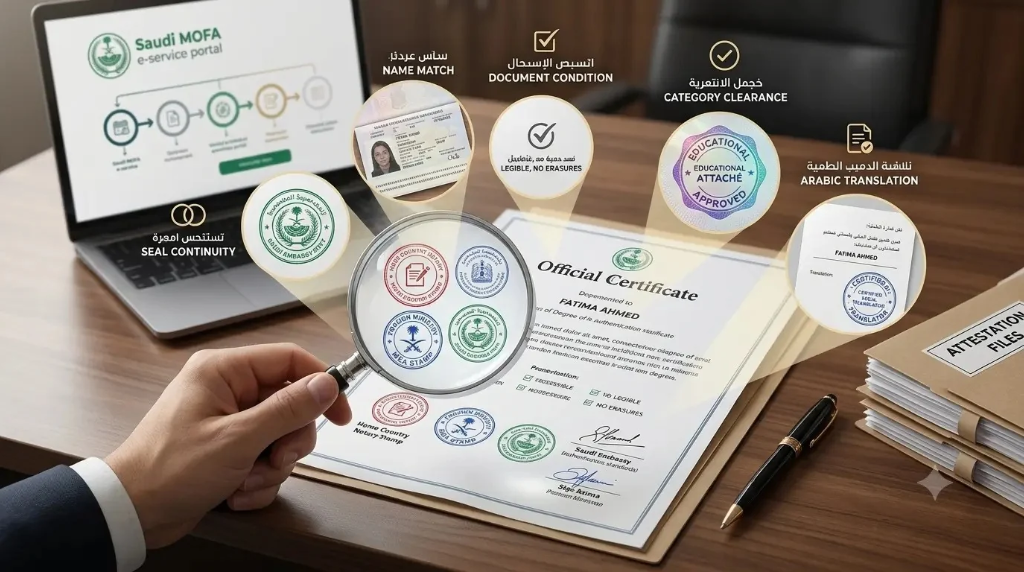
Saudi MOFA ratifies a finished chain of endorsements, and it rejects any file with a gap. Five checks decide yours: seal continuity, name match, document condition, category clearance and Arabic translation.
Picture an engineer who lands in Riyadh with a degree carrying four stamps. Her employer’s HR desk returns it in minutes, because one earlier stamp is missing. This is an illustrative case, not a client story, but the failure it shows is real.
This guide shows what each check looks at, so you fix gaps before paying any fee. Our Saudi document attestation services page covers the full route from start to finish.
The Five Checks at a Glance
MOFA looks at five things, and each one has a clear pass condition. Fail any one of them, and the file stalls before ratification even begins.
| No | Check | Passes when |
| 1 | Seal continuity | Notary, foreign ministry and Saudi embassy stamps are all present |
| 2 | Name match | The document name matches your passport and supporting records |
| 3 | Document condition | The original is complete, legible and free of erasures |
| 4 | Category clearance | The category’s own authority has endorsed the file |
| 5 | Arabic translation | The translation meets the recipient’s standard and matches the original |
MOFA publishes no inspection manual, so these checks follow its endorsement chain and public Saudi rules. Treat them as the minimum, and confirm details with the Saudi recipient.
The Five Checks in Detail
Seal Continuity
MOFA needs an unbroken chain from notary to foreign ministry to Saudi embassy. It ratifies the embassy’s signature, so a missing link leaves nothing to ratify.
Each stage vouches only for the signature added by the stage before it. The foreign ministry never reads your certificate’s content, and the embassy never re-checks the notary.
Confirm these four points on the original before you submit it to anyone:
- The issuing authority or notary has signed the original.
- The foreign ministry stamp, such as MEA in India, is present and readable.
- The Saudi embassy or consulate stamp is present and readable.
- Every stamp sits on the document you are submitting.
Apostilled documents follow a shorter chain than the traditional route does in most cases. Read our guide to the Saudi apostille process for the Hague route.
Name Match
Your name on the document must match your passport character by character. A mismatch in spelling, order, spacing or transliteration stops the file at review.
The Saudi Ministry of Education sets a strict version of this rule for certificates. It requires the holder’s name to match prior academic records and at least one identity document.
Never alter an original document in any way to force a match. Ask the issuing authority for a corrected record or supporting evidence instead.
Document Condition
The original must be complete, fully legible and free of any erasures or overwriting. The Ministry of Education requires certificates with no erasures or modifications and rejects altered documents.
MOFA’s own page lists no condition standard, so apply the strictest rule to every category. A document that passes the stricter test also passes the looser one.
Inspect the original page by page for these four problems before you apply:
- Missing pages, attachments or reverse-side endorsements.
- Illegible stamps, signatures, dates or reference numbers.
- Handwritten corrections or overwritten text.
- Damage that hides official details.
Never peel off lamination at home, because it can tear stamps and security features. Ask the issuing authority how to get a clean replacement before you apply.
Category Clearance
Each document category needs its own clearance before MOFA acts on the file. MOFA’s e-service covers five categories: educational, agency and marriage contracts, commercial, letters, and personal status documents.
For degrees, the Saudi cultural attaché adds a clearance on top of the embassy stamp. The Ministry of Education requires the issuing country’s education body, its foreign ministry and the Saudi embassy.
| Document category | Clearance to complete first |
| Degrees and educational certificates | Education authority, then the Saudi cultural attaché |
| Birth and marriage certificates | Civil registration authority endorsement |
| Commercial documents | Chamber of Commerce endorsement, where the paper type needs it |
| Agency documents and powers of attorney | Notarisation and legal authentication |
| Letters | The issuer’s authority and its own endorsement |
Attestation is not professional approval, and the two are entirely separate processes. A nurse with a fully attested degree still needs credential checks, which our QPV Services page covers.
Degrees from Hague member countries have their own route, described under Degree Certificate Apostille.
Arabic Translation
Translate only when the Saudi recipient asks for Arabic, and use a translator it accepts. MOFA’s page does not mention translation, so the recipient sets the standard.
The Ministry of Education requires certified translation for certificates not in Arabic or English. Use that rule as the working benchmark for every other document category you handle.
A sound translation meets these four standards, whichever category your document belongs to:
- A certified legal translator signs and stamps the translation.
- Names, dates and reference numbers match the source exactly.
- Every stamp and endorsement on the original is translated.
- The translation travels with the original in one file.
A translation never replaces the authentication of the original document itself, in any category. Complete both steps whenever the Saudi recipient names both of them in its checklist.
How the MOFA E-Service Works
You apply through MOFA’s electronic portal, pay online, and wait for review. The ministry’s Board, one of its branches, or a mission abroad reviews the request.
Payment runs through Sadad, and requests made through missions abroad use Enjaz instead. MOFA’s service page lists no fee amounts, so check the portal before you pay.
Confirm that your whole endorsement chain is complete before you pay anything at all. Payment only starts the review, and it does not repair a broken chain.
Why Files Get Stuck
Most files stall because of a gap in the chain, a name mismatch or a damaged original. These six problems cause most of the delays in Saudi attestation files today:
- Incomplete authentication: one endorsement in the chain is missing.
- Identity mismatch: the name differs from the passport or supporting records.
- Document damage: stamps, signatures or text are unreadable.
- Wrong category: the application uses the wrong document type.
- Translation problems: the translation fails the recipient’s standard.
- Borrowed procedures: the applicant follows another country’s route.
Some of these are preparation risks, not official MOFA rejection grounds, yet each one still costs weeks. Fix each one before you apply, because a rejected file restarts the chain from the gap.
Prepare Before You Submit
Prepare in seven steps, and finish each one before you start the next. This order removes the most common causes of rejection before they reach the ministry.
- Identify the document category. Decide whether it is educational, personal, commercial or legal.
- Confirm the country of issue. Use that country’s own authentication route.
- Check prior endorsements. Verify notary, foreign ministry and Saudi embassy stamps.
- Compare identity details. Match names against the passport and supporting records.
- Inspect the original. Look for missing pages, unclear stamps and alterations.
- Confirm translation rules. Order certified translation only when the recipient asks.
- Apply through the official MOFA portal. Pay through Sadad, or Enjaz for missions abroad.
Run a free Pre-Check before step seven, and send us a scan. We review it against the five checks and name any gap before an original moves. Our Saudi MOFA Attestation Services page explains the full ministry route in plain steps.
Get Help in Your City
Local support depends on where your Saudi recipient or employer sits in the Kingdom. Choose the city page nearest to them, then follow the route on that page.
- Riyadh attestation services for the capital and Riyadh Province.
- Jeddah attestation services for the Western Province.
- Dammam attestation services for the Eastern Province.
Frequently Asked Questions
MOFA checks that your endorsement chain is complete, from notary to Saudi embassy. The ministry publishes no inspection manual, so this comes from its chain and public rules.
Yes, a missing stamp breaks the chain, and the next officer cannot verify the signature. The right sequence depends on your type of document and on the issuing country.
No, never write corrections by hand on an official document of any kind. Ask the issuing authority for a corrected record, because an alteration can sink the file
No, translation depends on the type of document and on the Saudi recipient involved. Ask the recipient, and use a certified legal translator when it requires one.
No, MOFA ratification and academic equivalency are two separate procedures run by two separate bodies. The Ministry of Education handles equivalency decisions under its own published rules and regulations.
No, attestation does not guarantee acceptance by any employer, licensing body or regulator. The receiving organisation alone decides whether its own requirements have been met in full.
Get Your Documents Checked
A Pre-Check names your likely gaps before any original leaves your hands. Share the issuing country, document type, intended use and any recipient instructions.
Request a free Pre-Check and we confirm the stages before any pickup is arranged. You can also contact Green Line Solutions to discuss your case with a team member. Our Saudi document attestation services page lists every route we handle in the Kingdom.
We are a private document service, not a government body, a ministry or an embassy. Authorities set the final requirements, and they change those rules without notice. This guide is general information, not legal advice or a guarantee of acceptance.